Musicians on Street Playing Redwork: A Designer's Review
When I first pulled up the Musicians on Street Playing Redwork file on my screen, I wasn't looking for complexity. As a designer who spends half my life untangling dense fill stitches and managing thread breaks, I was actually hoping for something clean, linear, and quick. Redwork has a specific charm—it relies entirely on the confidence of the line. There is no hiding behind satin columns or heavy fill densities. If the digitizing isn't crisp, the whole design falls apart. My initial impression of this machine embroidery design was promising; it captures a lively street scene with a minimalist aesthetic that feels both nostalgic and modern.
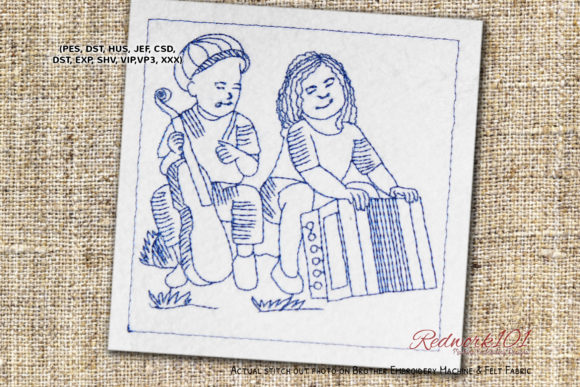
The mood this design creates is inherently cheerful and communal. It depicts musicians in action, likely with instruments that define their silhouette against the fabric. Because it is styled as redwork, the visual personality is graphic rather than realistic. This makes it incredibly versatile. It doesn't scream "look at me" with flashy gradients; instead, it invites the viewer to appreciate the flow of the stitching. For anyone running a craft business or an Etsy shop, this kind of subtlety often sells better than overly busy designs because it integrates seamlessly into various home decor styles and apparel trends.
Real-World Application: The Tote Bag Test
To truly evaluate how Musicians on Street Playing Redwork performs, I decided to test it on a project that sees a lot of wear and tear: a canvas tote bag. Tote bags are a staple for small shop products, but they present challenges due to the weave of the canvas and the potential for distortion. I hooped a heavy-weight cutaway stabilizer beneath the fabric, which is non-negotiable for redwork on textured materials. Without it, the running stitches can sink into the fabric texture, losing their definition.
The result was excellent. The single-color approach meant I didn't have to worry about color registration issues, a common headache in multi-color embroidery projects. The lines remained distinct, and the "street playing" theme felt perfectly at home on a bag meant for carrying groceries, books, or music gear. It transformed a plain utility item into a piece of art. I could easily imagine this working just as well on a linen tea towel for a kitchen gift or a denim jacket for a music festival look. The simplicity of the design allows the fabric choice to shine, making it a strong candidate for custom apparel where the garment quality is the selling point.
Navigating Fabric Choices and Hoop Constraints
While this digital embroidery file is robust, there are scenarios where you need to proceed with caution. Redwork, by nature, uses running stitches which can be tricky on stretchy fabrics like thin cotton jersey or rayon blends. If you are planning to use this for baby embroidery on a onesie, you must use a high-quality stabilizer, perhaps even topping the fabric with a water-soluble film to prevent the stitches from puckering or sinking into the nap of the fabric.
Another consideration is the hoop size. Although the description notes that the box stitch shown in some previews is optional, you need to verify the actual dimensions of the musician figures themselves before committing to a small hoop project like a cap or a sock. Curved surfaces, such as the front panel of a baseball cap, can distort linear designs if the framing isn't perfect. If the design includes fine details in the instruments or facial features, those might get lost on a highly textured towel or a thick fleece sweatshirt embroidery project. Always run a test stitch-out on a scrap piece of your intended material. This is the golden rule of professional commercial embroidery.
Regarding the optional outer box mentioned in the product details: treat this as a design decision rather than a technical requirement. In many redwork designs, a border helps frame the image, especially on large items like pillow covers or wall hangings. However, for something like an embroidered patch or a pocket detail on a shirt, skipping the box often yields a more organic, integrated look. Since the color of the outer box can vary in different versions of the file, you have the creative freedom to decide if it adds value to your specific finished product.
Elevating Product Value and Brand Consistency
From a business perspective, using Musicians on Street Playing Redwork can significantly enhance your brand's perceived value. Customers today appreciate handmade authenticity. A design that looks like it was drawn with a single continuous thread conveys a sense of artisanal skill. It suggests that the maker cares about the purity of the craft. This builds customer trust. When a buyer sees a clean, well-executed redwork design on a personalized gift, they associate that quality with your entire brand.
This design also works beautifully for seasonal collections. While it fits the general Music category year-round, it can be adapted for holiday gifts by changing the thread color. A deep green or gold thread could turn this street scene into a festive holiday decoration, while classic red keeps it traditional. For Etsy sellers creating printable mockups or digital product previews, the high contrast of redwork photographs exceptionally well. It pops against both light and dark backgrounds, making your online listings more engaging without needing extensive photo editing.
Final Designer Notes and Best Practices
Before you launch this design into your production queue, here are a few practical steps to ensure success. First, check the stitch density. Even though it is redwork, if the lines are too close together, they might merge during washing. Second, verify the licensing terms. Just because a file is available for purchase doesn't automatically grant unlimited commercial rights for every type of product. Confirm whether you can sell the physical handmade product or if there are restrictions on selling the design assets themselves.
Thread selection is key. Since this design relies on a single color (or very few), the sheen and quality of your thread will be highly visible. A matte cotton thread might give a rustic, vintage feel suitable for kitchen linens, while a shiny polyester thread could make the musicians pop on a backpack or gym bag. Finally, consider your audience. Is this for a child's room, a musician's gig bag, or a boutique home decor line? Musicians on Street Playing Redwork has the versatility to fit all these niches, but your presentation—framing, fabric choice, and placement—will dictate its final impact.
In conclusion, this design is a solid addition to any embroiderer's library. It balances artistic flair with technical practicality. Whether you are stitching a one-off gift for a friend or producing a run of merchandise for a local band, this file offers the reliability and charm needed to create standout items. Just remember to respect the limitations of the fabric you choose, and let the simplicity of the redwork style do the heavy lifting for your brand.